Reading in another language
How to read your first book in another language
Choose a book whose main action you can follow, read a short passage before looking anything up, and translate only what blocks your understanding. Then return to the original sentence. This guide shows how to try that routine, with an English example and four books to compare.
Start with a sample, not a level label
Read the opening paragraph and ask yourself who is there, where they are, and what is happening. If you can answer those questions, try a few more paragraphs. If almost every sentence needs translation, choose a simpler text or a graded reader written for learners. A famous children’s book is not automatically easy: wordplay, dialect and older vocabulary can be harder than the story suggests. The comparisons below are editorial observations about the texts, not assessed CEFR levels.
A worked example: Alice meets a puzzling word
In the opening of Alice’s Adventures in Wonderland, Alice looks into her sister’s book. Suppose “peeped” is unfamiliar. The words “into the book” and the reference to pictures suggest that she is looking inside it. You can still follow the scene without stopping. Keep reading, then check the word if you remain curious. Here it means looked briefly or secretly. You do not need to memorise it before continuing.
once or twice she had peeped into the book her sister was reading, but it had no pictures or conversations in it
Lewis Carroll, Alice’s Adventures in Wonderland, Chapter I (excerpt).
When should you translate?
Translate when you cannot tell who did something, whether an action happened, or why the next sentence follows. First reread the sentence with the one before it. If you are still stuck, translate the sentence as a whole and compare it with the original. A phrase can mean something different from its individual words. If an unfamiliar adjective only adds colour to a scene you already understand, leave it for later. This is a reading routine, not a rule against using a dictionary.
Try it in the Sentence reader
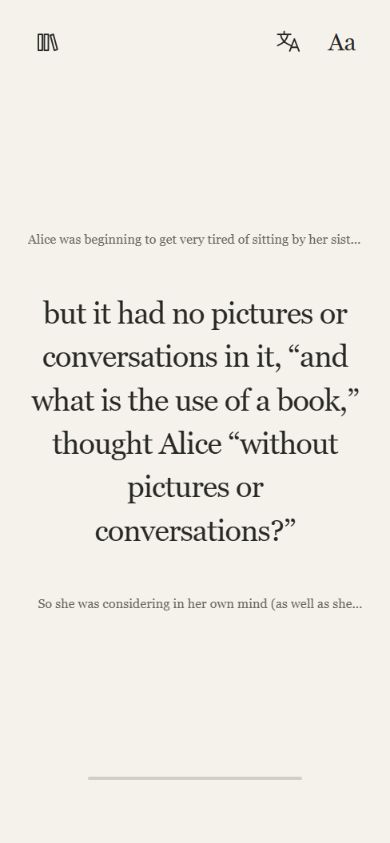
Open Alice using the button below and read a few sentences. Tap the translation icon when a sentence blocks you; hold the icon to choose the translation language. Read the translation, then return your attention to the original. Use Page view when you need the surrounding passage. Translation availability and allowances are shown in the reader; this guide does not assume unlimited translation. Machine translation can miss humour or ambiguity, so use it as a clue rather than a definitive literary interpretation.
Compare four English classics before choosing
Choose by the kind of difficulty you are willing to work through. Oz opens with concrete descriptions of a home; Alice quickly introduces jokes and impossible events. The Secret Garden adds dialect later, while Pride and Prejudice relies on social meaning as well as vocabulary. Try an opening passage before committing. These are original classics, not simplified learner editions. Check each book page for current availability and price.
| Book | Vocabulary and sentences | A good fit if… |
|---|---|---|
| The Wonderful Wizard of Oz | Concrete objects and actions; some long descriptive lists and older words such as “garret”. | You prefer a visible journey and can tolerate unfamiliar descriptive words. |
| Alice’s Adventures in Wonderland | Long opening sentences, dialogue, puns and invented situations. | You know the story and enjoy language jokes even when some need explanation. |
| The Secret Garden | Descriptive prose, older social vocabulary and Yorkshire dialect in dialogue. | You enjoy character-led stories and are ready for non-standard spellings. |
| Pride and Prejudice | Formal sentences, social vocabulary and irony that depends on context. | You already read English comfortably and want a literary challenge. |
Use a five-minute session
Spend the first minute recalling the scene or rereading your last sentence. Read for about three minutes, translating only where the action becomes unclear. Use the final minute to describe what happened in one simple sentence, in whichever language lets you check your understanding. If you want a vocabulary note, choose one useful expression rather than every unfamiliar word. These timings are a starting experiment, not a prescribed learning dose.
Decide whether to continue or switch
After several sessions, ask whether you want to know what happens next and whether you can follow the story without relying on a translation of every line. If yes, keep going. If not, try an easier book, a familiar story or a shorter text. Returning to a difficult novel later is a sensible choice. Reading can sit alongside conversation, listening and other practice; finishing a classic is not a guarantee of fluency.
Common questions
Should I translate every unfamiliar word?
For a session focused on following the story, start with words or sentences that block the meaning. You can use a separate study session for detailed vocabulary work.
Are these books suitable for complete beginners?
They are unabridged classics, so they may be too demanding for a first encounter with English. Try a graded reader or short learner text if you cannot follow the main action.
Does this routine work for languages other than English?
You can try the same read, check and reread routine in another language. The examples and book comparison here are specifically English; vocabulary and grammar challenges will differ.
Do I need Sentence to use the routine?
No. You can use a paper book and dictionary or another reader. Sentence offers sentence-by-sentence reading and translation inside the reader if that format suits you.